I have talked about my past employer, Boeing, a few times on this blog, but I haven't mentioned Intel. I worked in process engineering in the (tungsten) chemical vapor deposition area out in Aloha, OR. Not my cup of tea in many respects. Making chips and the technology (which is fairly cutting edge) are not things that greatly interest me and the corporate culture was not something I cared for. Plus, the whole
clean room stuff and wearing
bunny suits did not thrill me, not to mention working with non-life affirming chemicals/gases wasn't my idea of fun.
Since I had a sick kid last night, don't have much to say today, but heard Intel was building a new facility in the Evil Empire, so thought I'd include a brief bit on that.
From the
EE Times:
Intel Corp. on Saturday (Sept. 8) broke ground on its first 300-mm wafer fabrication facility in Asia. The new plant, named Fab 68, is located in the northern China city of Dalian, in the Liaoning Province.
Intel's China fab was originally announced in March. The $2.5 billion project is set to be operational in 2010. It will produce chipsets, based on a 90-nm process. Fab 68 will cover 163,000-square-meters of factory space and host a 15,000-square-meter clean room.
Intel investment in Fab 68 sets its total investment in China to close to $4 billion. Intel has established two assembly and test plants in Shanghai and Chengdu, along with R&D centers and labs in Beijing, Shanghai and elsewhere in China.
"Fab 68 will have world-class infrastructure and be an integral part of our global manufacturing network while bringing us closer to our customers and partners in China," said Craig Barrett, chairman of Intel, in a statement. "Intel's investment in Fab 68 comes at a time when Dalian's information technology industry is aiming to compete globally and become one of the top three IT clusters in China," said Dalian Mayor Xia Deren, in the same statement. "Fab 68 is not just bringing advanced chipset manufacturing to Dalian," he said. "Intel's presence will attract investment from virtually every segment of the IC industry, which in turn will have tremendous effect on the region's economy and industries."
________________________________________________
 Picture of a silicon ingot that is grown and then cut into wafers
A
brief overview of how silicon is turned into the material that chips are made from.
If you have any interest, here is a Wiki
link on Chemical Vapor Deposition
and another, more in depth
link.
________________________________________________
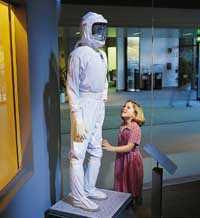
Wearing a bunny suit, from the
Intel website (what I had to do every day just to get out in the fab):
"Cleanrooms are 10,000 times cleaner than a hospital operating room. It takes an incredible amount of technology to achieve and maintain such cleanliness. Huge air filtration systems completely change the air in cleanrooms about 10 times per minute, reducing the chance that there are airborne particles that might harm the chips.
Keeping the environment clean, however, is only half of the story. What about the people who work in the cleanrooms? The thousands of people who work in Intel cleanrooms all wear special uniforms called "bunny suits" to protect the chips from human particles such as skin flakes or hairs. A bunny suit is made from a unique non-linting, anti-static fabric and is worn over street clothes.
At the Intel Museum, you can see what our BunnyPeopleT look like. Bunny suits come in a range of colors, as long as you like white.
Suiting up is a rather involved process, not to mention that every time you enter and leave a cleanroom you have to repeat the steps below:
(They forgot to mention you have to go through an air shower and walk across fly-paper before the following steps) 1. Store personal items.
2, Discard any gum, candy, etc.
3. Remove any makeup with cleanroom soap and water.
4. Take a drink of water to wash away throat particles.
5. Cover any facial hair with a surgical mask or beard/mustache lint-free cover.
6. Put on a lint-free head cover.
7. Clean shoes with shoe cleaners (think they are referring to the fly-paper here)
8. Put shoe cover on over shoes.
9. Clean any small, pre-approved items to be taken inside.
10. Pick up booties.
11. Sit on "dirty" side of bench.
12. Put on one bootie (over plastic shoe cover).
13. Swing bootied foot to "clean" side of bench.
14. Put on other bootie on "dirty" side.
15. Swing bootied foot to "clean" side.
16. Enter main gowning room.
17. Set aside badge, pager, and any other items to be taken inside.
18. Put on nylon gowning gloves.
19. Obtain bunny suit and belt from hanger.
20. Put on bunny suit without letting it touch the floor.
21. Put on belt.
22. Tuck bunny suit pant legs into booties.
23. Fasten snaps at top of booties.
24. Attach filter unit to belt.
25. Attach battery pack to belt.
26. Plug filter unit into battery pack.
27. Obtain helmet, safety glasses, and ID badge from rack.
28. Put on helmet.
29. Tuck helmet skirt into bunny suit.
30. Zip up bunny suit at shoulders.
31. Attach helmet hose to filter unit.
32. Tighten knob at back of helmet.
33. Put on ID badge.
34. Put on pager.
35. Put on safety glasses.
36. Obtain disposable scope shield.
37. Remove protective covering from both sides of scope shield.
38. Undo front helmet snaps.
39. Attach face shield to helmet.
40. Re-snap front helmet snaps.
41. Examine attire in mirror.
42. Put on latex gloves.
43. Enter the cleanroom.
If you've never done it before, putting on a bunny suit can take 30 to 40 minutes. The Intel pros can do it in five."


